

All posts
Published
March 31, 2026
Introducing Med Sales Hub: A New Approach to Industry Scheduling

Tom DeBarto
MSH Staff

For decades, the relationship between medical practices and industry representatives has played a meaningful role in healthcare. Pharmaceutical representatives, medical device specialists, and diagnostic experts regularly meet with physicians and clinical staff to share information about new therapies, technologies, clinical research, and patient support programs. These interactions help clinicians stay informed about innovations that may improve patient outcomes.
Yet despite the importance of these relationships, the way industry meetings are scheduled has changed very little over time.
In many medical practices, industry visits are still managed through informal processes. Representatives may stop by clinics without appointments, hoping to catch a physician between patient visits. In other cases, they call the front desk to request meetings or ask office staff to relay messages to clinicians. While these methods have been used for years, they often create inefficiencies for both medical practices and industry representatives.
Healthcare has undergone enormous digital transformation over the past two decades. Electronic medical records, telehealth platforms, and automated scheduling systems have modernized many aspects of clinical operations. Yet the coordination of industry engagement has largely remained manual and inconsistent.
Med Sales Hub was created to address this gap.
By introducing a smarter, technology-driven approach to industry scheduling, Med Sales Hub aims to modernize the way medical practices and industry representatives coordinate meetings—bringing structure, fairness, and efficiency to an area that has long relied on informal processes.
The Traditional Model of Industry Scheduling
To understand the value of a new scheduling approach, it is helpful to look at how industry meetings have traditionally been coordinated.
Historically, medical sales representatives have relied heavily on in-person visits to healthcare practices. Representatives typically manage large territories and travel between clinics throughout the day, hoping to secure time with physicians or clinical staff.
In many cases, these visits occur without a scheduled appointment. Representatives may arrive at a practice and sign in at the front desk, asking whether a physician has a few minutes to talk. If the clinic is busy, the representative may leave materials or ask to schedule a future visit.
This approach creates several challenges.
First, representatives often spend significant time traveling between offices without knowing whether they will actually meet with a physician. A single day in the field may involve multiple unsuccessful visits.
Second, front desk staff are frequently responsible for coordinating these interactions. Staff members must determine whether clinicians are available, relay messages, or manage representatives waiting in the lobby.
Third, physicians often have limited time to meet with representatives due to packed patient schedules and administrative responsibilities.
These challenges have become more pronounced as healthcare practices grow busier and operational efficiency becomes a higher priority.

Why the Current System No Longer Works
The traditional model of industry scheduling developed during a time when healthcare practices operated differently than they do today. Physicians often had more flexibility in their schedules, patient volumes were lower, and administrative requirements were less complex.
Modern healthcare practices operate in a very different environment.
Clinicians now face intense time pressure, balancing patient care with documentation, regulatory requirements, and coordination with other healthcare providers. Front desk teams manage high patient volumes while also handling scheduling, insurance verification, and administrative tasks.
In this environment, unstructured industry visits can create disruptions rather than value.
Medical practices must constantly balance the educational benefits of industry engagement with the need to maintain efficient clinic workflows. Without structured scheduling systems, these interactions can be difficult to manage.
At the same time, industry representatives face increasing pressure to manage larger territories and maintain relationships with hundreds of healthcare providers. Traveling between practices without scheduled meetings wastes time and reduces productivity.
Both sides of the equation—medical practices and industry representatives—are looking for a better way.
A New Model for Industry Engagement
Med Sales Hub introduces a modern approach to coordinating industry meetings by providing a digital platform that connects medical practices with verified industry representatives.
Instead of relying on informal drop-in visits or manual coordination, representatives can request meetings through the platform, while practices maintain control over when and how those meetings occur.
This structured approach transforms the scheduling process from a reactive system into an organized, predictable workflow.
Medical practices can define their preferences for industry engagement, including when meetings are available and what types of representatives they wish to meet with. Representatives can request meetings through the platform and receive confirmation without needing to rely on cold visits or repeated phone calls.
By bringing both groups into a centralized system, Med Sales Hub creates a more efficient and professional environment for industry collaboration.
Designed for Medical Practices
One of the core principles behind Med Sales Hub is that medical practices should maintain full control over industry access.
In the traditional model, practices often feel overwhelmed by unscheduled visits or constant requests from representatives seeking meetings. Front desk teams frequently act as gatekeepers, managing interactions while also juggling their many patient-related responsibilities.
Med Sales Hub removes this burden by allowing practices to manage industry engagement on their own terms.
Practices can designate specific time windows for industry meetings—such as lunch hours or scheduled educational sessions—ensuring that interactions occur without disrupting patient care.
They can also define policies around meeting frequency or the types of industry representatives they wish to engage with.
By establishing clear structure and expectations, practices gain the benefits of industry education without the operational disruption that often accompanies traditional scheduling methods.
A Better Experience for Industry Representatives
Industry representatives also benefit significantly from a structured scheduling platform.
The traditional model of field sales often involves unpredictable outcomes. Representatives may travel long distances to visit practices only to discover that clinicians are unavailable or that the office is too busy to accommodate a meeting.
Med Sales Hub replaces this uncertainty with predictability.
Representatives can request meetings directly through the platform and receive confirmation in advance. This allows them to plan their schedules more efficiently and focus their time on meaningful interactions rather than waiting in clinic lobbies.
Structured scheduling also helps representatives prioritize practices that are actively open to industry engagement. Rather than guessing which clinics may be receptive, representatives can focus their efforts where meetings are more likely to occur.
This leads to better use of time and stronger professional relationships with healthcare providers.
AI-Powered Scheduling Coordination
One of the defining features of Med Sales Hub is its use of artificial intelligence to support the scheduling process.
The platform’s AI scheduling engine evaluates multiple factors when coordinating meetings between representatives and medical practices. These factors may include practice preferences, representative territories, specialty alignment, and scheduling availability.
By analyzing these variables, the system can help ensure that meetings are coordinated efficiently while maintaining fairness and balance across representatives.
AI also helps eliminate the “refresh race” that sometimes occurs in traditional scheduling systems, where representatives compete to secure limited meeting slots by constantly refreshing appointment calendars.
Instead, Med Sales Hub uses intelligent scheduling logic to distribute meeting opportunities in a way that promotes equitable access while still prioritizing relevance and efficiency.
.jpg)
Ensuring Fair Access
Fair access is an important part of Med Sales Hub’s approach to industry scheduling.
In many traditional systems, access to physicians can depend heavily on factors such as proximity, personal relationships with office staff, or simply being the first representative to arrive at a clinic.
This dynamic can create uneven opportunities for representatives and limit the diversity of information physicians receive.
Med Sales Hub’s scheduling algorithm is designed to create a more balanced environment where representatives compete based on the relevance and value of the information they provide rather than on informal advantages.
By distributing meeting opportunities more equitably, the platform helps ensure that clinicians hear from a broader range of industry experts while maintaining structured control over their schedules.
Reducing Front Desk Disruption
Front desk teams are often the unsung heroes of medical practice operations. They manage patient interactions, coordinate schedules, answer phone calls, and keep the clinic running smoothly throughout the day.
In many practices, these staff members are also responsible for managing interactions with industry representatives—a task that can add significant pressure to their workload.
Med Sales Hub removes this burden by shifting industry coordination away from the front desk and into a dedicated scheduling platform.
Representatives request meetings digitally rather than calling the office or arriving without appointments. Automated notifications and confirmations ensure that both parties have the information they need without requiring manual coordination by staff.
This allows front desk teams to focus on patient care rather than managing industry visits.
Building a Professional Network for Healthcare Engagement
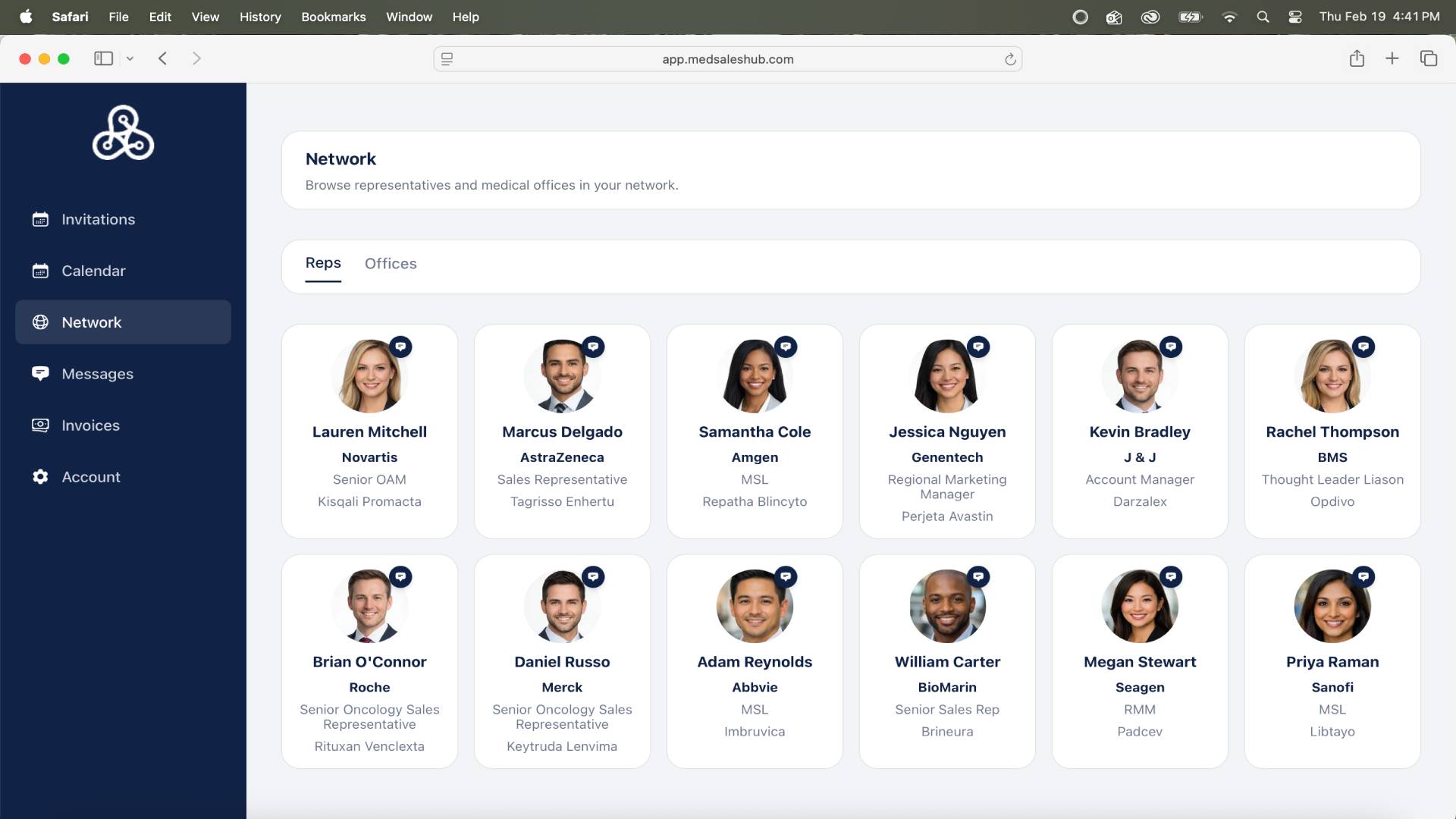
Beyond scheduling, Med Sales Hub is designed to become a professional network connecting medical practices and industry representatives.
The platform creates a verified environment where practices can interact with legitimate representatives from pharmaceutical companies, medical device manufacturers, diagnostic organizations, and other healthcare companies.
This network structure encourages more transparent and professional communication between the two groups.
Practices gain visibility into the representatives requesting meetings, while representatives gain access to practices that are open to structured engagement.
Over time, this network can help strengthen relationships across the healthcare ecosystem, creating a more collaborative environment where industry education and clinical practice intersect.
Supporting the Future of Healthcare Collaboration
The healthcare industry is moving toward greater digital coordination across all aspects of care delivery.
Patient scheduling systems have become more advanced. Telemedicine platforms have expanded access to care. Data analytics tools are helping clinicians make more informed decisions.
Industry engagement is simply the next area ready for modernization.
By introducing a centralized platform for scheduling and communication, Med Sales Hub aligns industry collaboration with the broader digital transformation occurring across healthcare.
Instead of relying on outdated methods such as drop-in visits or manual coordination, practices and representatives can interact through systems designed specifically to support modern clinical workflows.
A Platform Built for Growth
As more medical practices and industry representatives join Med Sales Hub, the platform’s network effects will continue to expand.
Practices will gain access to a broader range of industry experts and educational resources. Representatives will gain more opportunities to connect with healthcare providers in a structured and efficient way.
Artificial intelligence will continue to improve scheduling coordination as the system learns from engagement patterns across the network.
This growth will help create a more connected healthcare ecosystem where collaboration between clinicians and industry professionals becomes easier, more transparent, and more productive.
The Future of Industry Scheduling
The days of representatives waiting in clinic hallways for unscheduled meetings may gradually give way to a more organized system.
Digital scheduling platforms like Med Sales Hub represent the next step in the evolution of industry engagement.
In this future model:
Medical practices maintain full control over when and how industry meetings occur.
Front desk staff are no longer responsible for coordinating representative visits.
Industry representatives schedule meetings efficiently and plan their territories more effectively.
Artificial intelligence ensures fair access and optimized scheduling.
The result is a system that benefits everyone involved while preserving the valuable educational exchange that has long existed between healthcare providers and industry professionals.

Conclusion
The relationship between medical practices and industry representatives has always been an important part of healthcare innovation. Yet the systems used to coordinate these interactions have remained outdated for far too long.
Med Sales Hub introduces a new approach to industry scheduling—one that brings structure, transparency, and efficiency to a process that has historically relied on informal coordination.
By combining digital scheduling tools, artificial intelligence, and a professional network designed specifically for healthcare engagement, Med Sales Hub provides a smarter way for practices and representatives to connect.
Medical practices gain control over their workflows and reduce administrative burden for staff. Industry representatives gain predictable access and more meaningful opportunities to engage with clinicians.
Most importantly, the platform supports the exchange of valuable clinical information that ultimately helps improve patient care.
As healthcare continues to evolve, the systems that support collaboration between clinicians and industry professionals must evolve as well.
Med Sales Hub represents the beginning of that transformation.